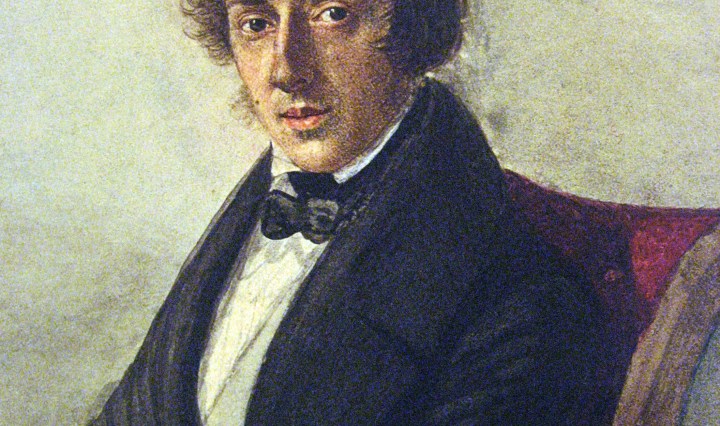
Chopin: Variations on ‘Là ci darem la mano’ for piano and orchestra, Op. 2

performed by Idil Biret and the Slovak State Philharmonic orchestra under Robert Stankovsky Eusebius came in quietly the other day. You know the ironic smile on his pale face with which he seeks to create suspense. I was sitting at … Continue reading Chopin: Variations on ‘Là ci darem la mano’ for piano and orchestra, Op. 2

Mozart Piano sonata no. 2 in F, KV280

performed by Mitsuko Uchida second movement third movement As with many of the pieces we have discussed in rapid succession, this piece was written soon after yesterday’s sonata. Do remember the statement we made about the clump of the first four piano concertos: with such little space between them, and from such a young composer, I wouldn’t expect to see any large degree of development or advancement from one piece to another. What I do feel like I see, as mentioned with the juvenile orchestrations, is greater confidence. The young Mozart is, perhaps, getting his sea legs, as it were.  … Continue reading Mozart Piano sonata no. 2 in F, KV280

Mozart Piano sonata no. 1 in C, K279

performed by Mitsuko Uchida second movement third movement   No more concertos for now. Move ahead another year, and our dear composer is now 18 years old. He’d have graduated high school by this time if that’d been a thing, and he finally got around to writing his first full piano sonata. I’m interested as to why it isn’t until now that his first completed piano sonata is composed. That being said, he’d written tons of smaller things in his youth, but his first completed three-movement work for solo piano comes some time after his first opera or concerto or … Continue reading Mozart Piano sonata no. 1 in C, K279

Mozart Piano Concerto no. 5 in D, K175

performed by the English Chamber Orchestra under Jeffrey Tate, Mitsuko Uchida, piano Finally something original. So it’s been 24 hours since our last Mozart concerto, and a few years since our little composer put his pen to paper for another concerto. This one, however, is original. I’ll make mention that I’m not including the three unnumbered concerti orchestrated from sonatas of J.S. Bach, mostly because they’re not numbered and because I didn’t know they existed (because they aren’t included in any of the box sets I’ve been browsing), mostly the latter. I might get around to them eventually, but then … Continue reading Mozart Piano Concerto no. 5 in D, K175

Mozart Piano Concerto no. 4 in G, K41

performed by Philharmonia/Ashkenazy, or below by Perahia/English Chamber Orchestra Maybe I’ve figured out what it is. I would say confident! This piece feels even more confident than the third. I feel better about thinking of that word. Why? Well, think of a composer who changed throughout his career. That shouldn’t be hard. Sibelius comes to mind, for no particular reason. His first two symphonies (taking them as an example) are quite traditional in their Romantic-ness, but then with the third, things change. It’s pared down and almost neo-classical. And then he becomes even more unique, all the way up to … Continue reading Mozart Piano Concerto no. 4 in G, K41

Mozart Piano Concerto no. 3 in D, K40

performed by either Ashkenazy/Philharmonia, or below by Perahia/English Chamber Ochestra Number three. The year is (still) 1767, and our little composer is still eleven years old. Everything is the same, except we get trumpets in addition to keyboard, strings, horns and oboes. Again, three movements, but none of which based on Raupach. Wikipedia says: The first movement is based on the initial movement of Honauer’s Op. 2, No. 1. The second on one by Johann Gottfried Eckard (op. 1, no. 4 ), the most famous keyboardist of his day. The third movement is based on C. P. E. Bach‘s piece … Continue reading Mozart Piano Concerto no. 3 in D, K40

Mozart Piano Concerto no. 2 in Bb, K39

by Ashkenazy/Philharmonia or below, as usual, by Perahia/English Chamber Orchestra Yesterday’s piece was K37, and this is K39. It seems the young, ambitious, precocious Mozart took a break from his string of piano concertos for his K38. He wrote an opera. At eleven years old. And then he came back to piano concertos, and that’s where we are today. Following the circle of fifths for flats, we come from F major yesterday to Bb major today. This concerto was written only a few months after yesterday’s K37, and uses the same forces. It is a few minutes shorter, and also … Continue reading Mozart Piano Concerto no. 2 in Bb, K39

Mozart Piano Concerto no. 1 in F, K37

performed by The Philharmonia Orchestra under Vladimir Ashkenazy, (or the below with Murray Perahia and the English Chamber Orchestra) As mentioned yesterday, we’re starting a very long stretch of almost-daily posts, with lots of piano works by some very important composers.  For future reference, all Mozart concertos will be taken from the above-mentioned Ashkenazy/Philharmonia set. We begin today with the first of five Mozart piano concertos. This one was written when the young composer/pianist was eleven years old. It turns out these works were long considered to be original, but later found to be orchestrations of other German works. A … Continue reading Mozart Piano Concerto no. 1 in F, K37

Concert Review: 簡韻玲鋼琴獨奏會

or my piano teacher’s graduation recital at 師大 I missed her other recital, and felt terrible about it, but was glad I was able to attend this one. If you go check out the About Me section, I talk in there about my final decision to go get piano lessons like I’d always wanted, so I did. I was cohost of a radio show for a local news channel at the time, and happened to mention to the host in passing that I’m looking for a piano teacher. Turns out his cousin and her whole family are music people. He … Continue reading Concert Review: 簡韻玲鋼琴獨奏會

Concert Review: 2015師大音樂系交響樂團公演: Phenomenon

The 2015 NTNUSO Concert: Phenomenon So, this is one of those concerts you go to for fun. I had the same feelings about a concert last month with the Taipei Symphony, and was blown away. The last concert we reviewed (last week) was the Taipei Symphony’s performance of Mahler 3 under Maestro Eliahu Inbal. This concert was the day after that. I was invited a few days ahead of time to go with a friend at the university who had tickets. I didn’t know anything on the program, but it was a nice opportunity to go, so I certainly didn’t … Continue reading Concert Review: 2015師大音樂系交響樂團公演: Phenomenon

Concert Review: Taipei Symphony and Karen Gomyo

Bear with me here. This concert (or the general experience of the evening) was far more outstandingly outstanding than I’d prepared for.  There are some concerts you look forward to and know will be once-in-a-lifetime chances, like being able to hear Gurre Lieder live last year (quite a production), or The Philharmonia last month, and some you go to just because it’s a nice chance to hear a piece live again, with no real concern for the performer or real anticipation for the program…? Think of it this way.  There are different kinds of dinner plans: I may make plans far … Continue reading Concert Review: Taipei Symphony and Karen Gomyo

Mozart Symphony no. 12 in G

performed by the ASMF/Marriner This is one of Mozart’s later childhood symphonies. He would still have been only about fifteen. It was written in Salzburg.  Also, this is a very half-hearted Mozart Monday. Partially because I’m exhausted, and partially because this symphony was…. just another early Mozart symphony. There’s nothing bad about that, but there’s nothing spectacular about it either.  A few things to note, though. It is in four movements, and the first is longer than any movement he had written up until that time. I suppose this symphony is close to being the longest of his symphonies so … Continue reading Mozart Symphony no. 12 in G

Mozart Symphony no. 11

performed by the ASMF/Marriner Believed to date from 1770, and possibly written in Milan or Bologna, this symphony is also suspected by some to have been written by either the father Leopold Mozart or by Carl Ditters von Dittersdorf (who is actually a real person with that name, who has a huge catalogue of compositions). Its status on Wikipedia is listed as uncertain, but some music historical claims confidently that it is Mozart the son who wrote this work. That’s about all the info Wikipedia has on it. Another expert claims there is “little special” about this piece, but I … Continue reading Mozart Symphony no. 11

Mozart symphony no. 10 in G

performed by the ASMF/Marriner This one was likely written during Mozart’s first journey to Italy, completed in 1770. That’s about all the information we get from Wikipedia about this piece. Mozart would then have been a young teenager. The first movement is pleasant enough, very classical, with high horns responding to lots of strings. The first part of this movement has a delightful dainty sort of energy. The only non-strings are oboes and horns. This string-heavy orchestration makes it feel even more classical and antique than some of his earlier pieces. What feels like a second movement is actually just … Continue reading Mozart symphony no. 10 in G

Mozart symphony No. 9 in G

performed by the ASMF/Marriner Mozart Monday again! Last MM I was halfway around the world. I’m back on the other half now, the half live on, and after a week and a half of listening and preparing for the recent Sibelius post, it feels a bit incomplete or premature to be posting this. It is, however, only a 9-minute symphony, and I listened to it about four times. Not much to say here, as it’s such a departure from the Sibelius I listened to for a week straight. Still a childhood symphony, published in 1770, making Mozart about 14 years … Continue reading Mozart symphony No. 9 in G

Mozart Symphony no. 8 in D

Performed by the ASMF/Marriner Mozart Monday from a special location: Milton, GA (another M, for Mozart Monday in Milton) In this week’s MM, we find our family still in Vienna, even after they should have been back in Salzburg. It was finished in 1768. This somehow feels super polished and although simple, tightly written and more mature, especially the first movement. It is predominantly strings, with oboe and flute calling out between the action here and there in the Allegro. It has great motion and feeling, and I feel this has more dynamic expression than any of the precious pieces. … Continue reading Mozart Symphony no. 8 in D

Mozart symphony no 7 in D, K. 45

Completed in 1768 after the family’s return to Vienna after a vacation and escape from smallpox. Parts of it were later refashioned into an opera (La Finta Semplice) and another entire symphony (K. 46a, the link for which on Wikipedia redirects to the aforementioned opera, but apparently the one I listened to, as the first movement is marked “Overture”) This one was likely premiered at a private performance. It’s a short one, but the two bits I enjoyed most were the first and fourth movements. The andante in 2/4 and the minuetto/trio are just fine, but didn’t much capture my … Continue reading Mozart symphony no 7 in D, K. 45