Anton Rubinstein: Symphony No. 2, ‘Ocean’

performed by the Russian State Symphony Orchestra under Igor Golovschin

The Russian Symphony Part 1

So I started writing about the piece we will talk about today, and then I realized I’d listened to and wrote about the wrong symphony. 

Sort of. I knew I had been preparing no. 5, but I chose it based on its success as a symphony of Anton Rubinstein that wasn’t his first, but still fell within the timeline we’ll be laying out with these works. Well, it turns out it was written decades after some of the other works on our list, so in the interest of chronological order, we jumped back a few symphonies to his second, subtitled ‘Ocean’. We will eventually get around to the fifth, but not any time soon, I don’t think.
We chatted a bit yesterday about Rubinstein’s background and his… position in the classical music scene in Russia, and it will become more significant after next week’s articles, but this work can be viewed perhaps as a representation of a Germanic Russian in Russia before things start to get really nationalistic and really Russian.
The second symphony from this Russian composer doesn’t feel terribly Russian or Symphonic. Perhaps in a world before Debussy’s La Mer, this piece would feel less like a large-scale tone poem, something it seemed to lean toward as the composer worked on the piece later.
Despite Liszt’s lack of willingness to give aid to the young, poor Rubinstein, the symphony bears a dedication to Liszt. Its first performance was on March 6, 1852, and the American Symphony program notes state:

… it won the favor of audiences with its magnificent trumpet calls, swirling melodies, and solid structure. The ocean, according to Rubinstein, is depicted in the contrasts between the agitated and peaceful passages, the deep lyricism of the second movement, and the heroic chorale at the end of the fourth movement, when man’s spirit gains domination over the power of the ocean.

Continue reading “Anton Rubinstein: Symphony No. 2, ‘Ocean’”

Influential People: Anton Rubinstein

I started including this information in tomorrow’s music post, but it got a little long, so I decided I’d make it a separate thing ahead of the discussion of the first work in our Russian symphony series. 

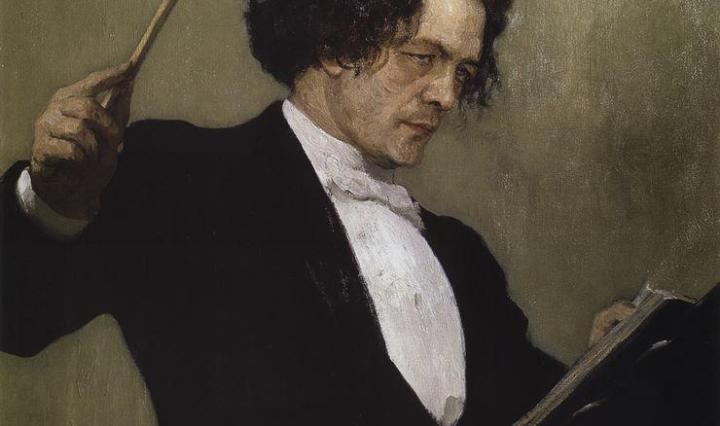
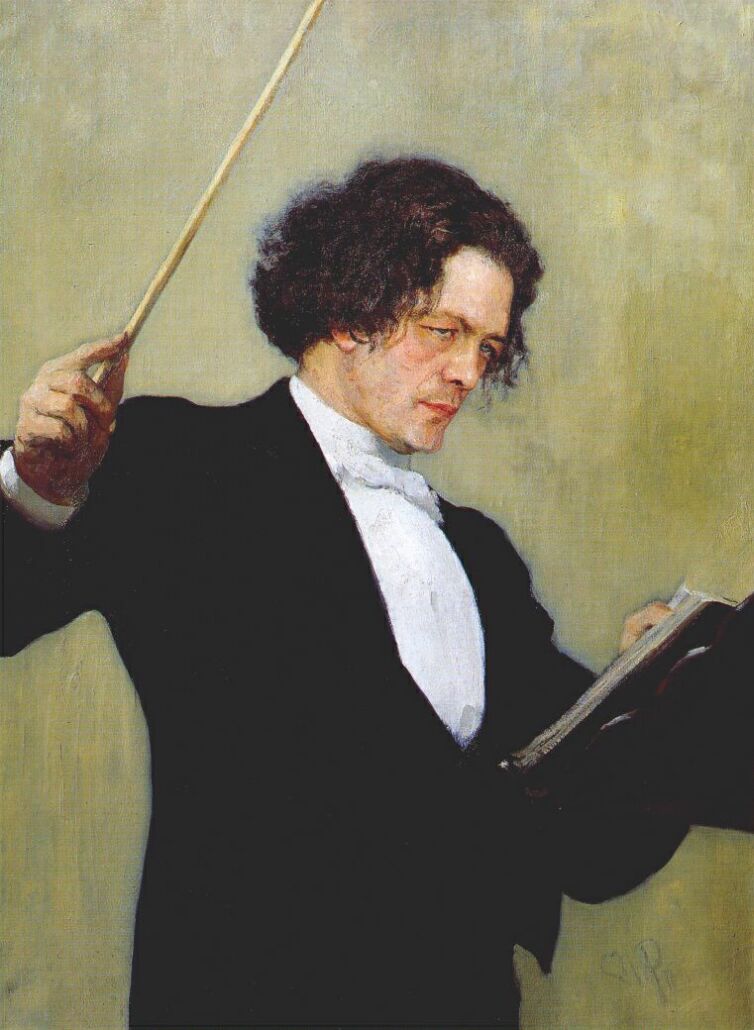
Rubinstein on the podium as portrayed by Ilya Repin.
In great contrast with the piece we’ll be discussing next week, Rubinstein was quite a Continue reading “Influential People: Anton Rubinstein”

Centenniel Music Post: Rachmaninoff Piano Concerto No. 3 in Dm, op. 30

performed by the Radio Symphony Orchestra Berlin under Riccardo Chailly; Martha Argerich, piano //player.vimeo.com/video/63725542 This is intimidating. I guess everything about this piece is except for listening to it, and sometimes even that. There’s so. much. to. say. about this piece that I almost don’t want to try. There are so many theses, recordings, liner notes, program notes, concert talks and everything else about this piece that it would be ludicrous for me to think I have anything else to add but my own opinion and feelings of the piece, so that’s pretty much all I’m going to share, aside from some basics. For the technical bits … Continue reading Centenniel Music Post: Rachmaninoff Piano Concerto No. 3 in Dm, op. 30

Concert Review: 葉孟儒 2015 Recital

I wouldn’t necessarily describe it as rare, per se, that one sees works of Alexander Scriabin on a recital program. I’d heard his piano works on at least two other occasions before this one, and was excited then, so when I saw the program for this recital months ago with three of Scriabin’s sonatas on the program, I immediately bought a ticket. Andrei Yeh is the same gentleman that so exquisitely played Rachmaninoff’s Paganini Variations back in December with the Taipei Philharmonic. I was blown away by that performance. It was one of those few times when something feels at … Continue reading Concert Review: 葉孟儒 2015 Recital

Prokofiev piano sonata no. 1 in Fm, op. 1

performed by Yefim Bronfman https://youtube.googleapis.com/v/z2EDk2Zsdik&source=uds It’s funny how life is. I’d planned the writing of this piece at least a month ago as a lead-in to another set of works for piano (the actual lead in was last week’s Satie piece, but this one sets up for what is to come later), and it was for a few reasons that now seem… less important than some others that have since surfaced. This piece is perhaps not as exciting to many as his other, later, more substantial works, but in a lot of (perhaps intentional, contrived ways), may have a lot to say about … Continue reading Prokofiev piano sonata no. 1 in Fm, op. 1

Prokofiev Piano Concerto No. 3 in C, op. 26

performed by the Israel Philharmonic under Zubin Mehta, Yefim Bronfman, piano (while I mention Wang below, and Argerich many times, I do quite enjoy Bronfman’s performance here. It’s a new album for me and I was pleased enough to listen to it instead of the other Argerich recordings and Wang’s with Abbado and the Lucerne Festival Orchestra; they’re all great) https://youtube.googleapis.com/v/KDfGBmbNbMw&source=uds The above is of the wonderful Yuja Wang and the Concertgebouw, under their (soon-to-be) new maestro, Daniele Gatti.  https://youtube.googleapis.com/v/NOybfjTRCdo&source=uds The above is of Ms. Martha Argerich herself. The first recording I had of this piece was of her and … Continue reading Prokofiev Piano Concerto No. 3 in C, op. 26

Rachmaninoff Piano Concerto No. 2 in Cm, op. 18

performed by the Royal Philharmonic Orchestra under Jascha Horenstein, Earl Wild, piano This may not be the most popular version of the work, but it’s the one I ‘learned’ this piece from; it’s the one I came to love this piece as a result of, and no other performance compares. It may be a bit brisker than a few other interpretations, but it’s perfect. These people knew what they were doing.  and this is a must-watch   Rachmaninov: Piano Concerto No. 2 (Nikolai Lugansky) from Philharmonia Orchestra on Vimeo. So…. This is an important piece. I’d been thinking what to … Continue reading Rachmaninoff Piano Concerto No. 2 in Cm, op. 18

Samuil Feinberg Piano Sonata no. 2, op 2

performed by Christophe Sirodeau https://youtube.googleapis.com/v/zheDyAzSVM0&source=uds So Samuil Feinberg was an extremely talented pianist, known for his transcriptions of Bach, as well as a complete recording of the Well-tempered Clavier. He studied at the Moscow Conservatory under Alexander Goldenweiser, a composer I’ve been meaning to get around to exploring. He won the Stalin Prize in 1946, and composed in his career twelve sonatas, as well as fantasies and other works for piano, some including voice, and three piano concertos, which Wikipedia also notes are not standard in the repertoire… I haven’t even heard them yet. I seem to recall not being … Continue reading Samuil Feinberg Piano Sonata no. 2, op 2

Nikolai Rimsky-Korsakov: Piano Concerto in C#m, op. 30

performed by the English Northern Philharmonia under David Lloyd-Jones,Malcolm Binns, piano This is unquestionably a very Russian piece, but it is also unquestionably a Lisztian piece.It was completed around 1883 and first performed in 1884 at one of Balakirev’s Free Music School concerts in St. Petersburg, by whom I am not sure.I am learning I’m not super fond of this Balakirev guy. As ignorant as I am of his works overall (aside from Islamey, and that just barely), reading about him makes him sound quite knowledgable and insightful, but this may just be more as a result of his familiarity … Continue reading Nikolai Rimsky-Korsakov: Piano Concerto in C#m, op. 30

Prokofiev Piano Concerto no. 2, op. 16

performed by the London Symphony Orchestra under Andre PrevinVladimir Ashkenazy, piano This was kind of Ashkenazy’s warhorse for a while I’m told. The Interwebs told me. This piece comes up often in the “hardest piano concerto ever” discussions that many an amateur like to have. I believe that comes from summing up the scope of the greatest challenge possible and putting things into perspective against it. Maybe. Anyway, Prok 2, Rach 2 and 3, Brahms 2, and Bartok 1 and 2 seem to be the ones that are most often agreed upon as being frighteningly, intensely difficult (obviously in different … Continue reading Prokofiev Piano Concerto no. 2, op. 16